Textile Mills & FibersTKT-5650
Uzbekistan Opens Cotton Harvest as Textile Sector Aims Upstream
Uzbekistan's cotton harvest is underway as Tashkent courts Turkish investment to shift its textile sector from cheap garments to higher-value apparel manufacturing.
- Cut
- October 2, 2026
- Sew
- 3 min
- Ticket
- TKT-5650
Construction
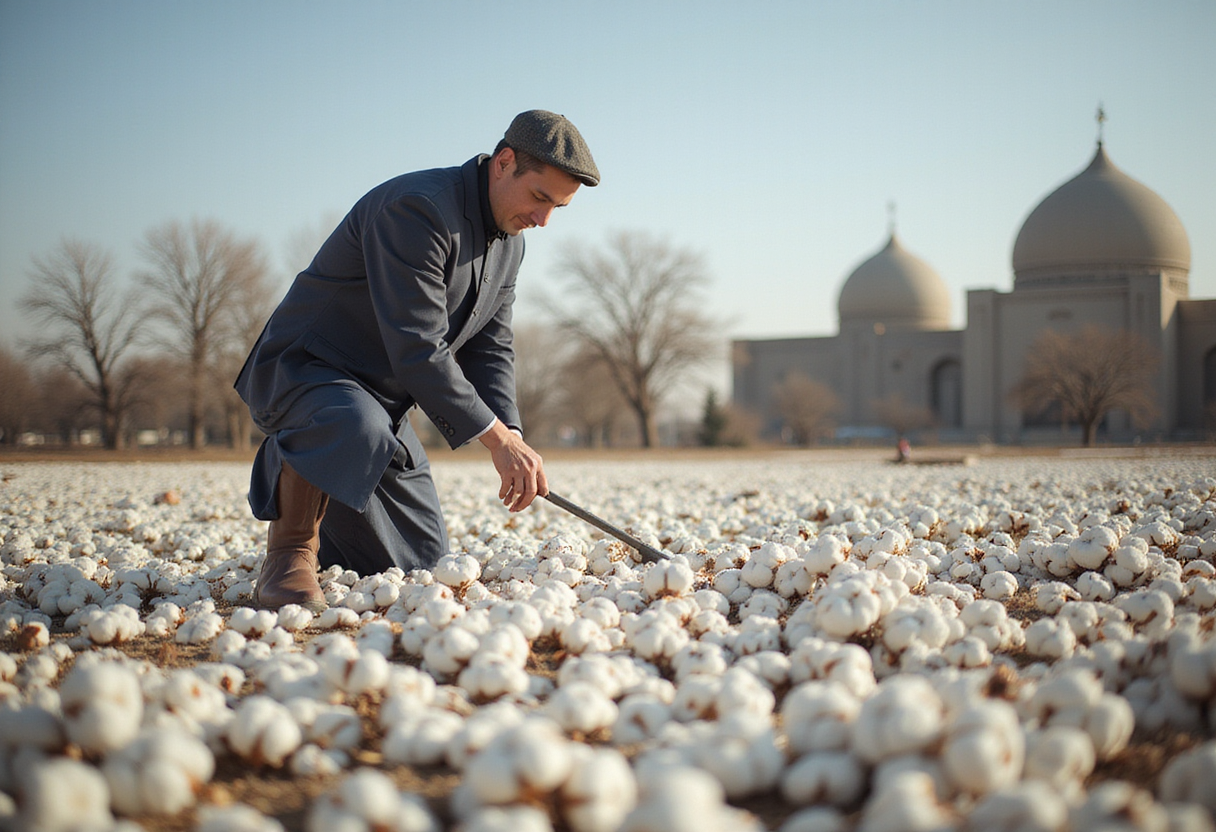
Uzbekistan has begun its cotton harvest as one of the world's leading cotton producers.
The Cotton Campaign lifted its boycott of Uzbek cotton in 2022 after the ILO confirmed the elimination of forced and child labour in the harvest.
Türkish manufacturers and investors are seen as the potential route for Uzbekistan to move beyond low-value garment exports into higher-value textile production.
Uzbekistan has begun its cotton harvest, an event that now carries more than agricultural significance. The country ranks among the world's top cotton producers, but the bulk of the value in its fibre still leaves the country — or leaves the factory floor — in the form of low-cost garments.
That is the trap Tashkent wants to escape. The question facing the sector, framed in recent Uzbek business media coverage as the harvest gets underway, is whether Turkish manufacturers and investors can help push the country's textile industry up the value chain.
The structural problem
Uzbekistan grows plenty of cotton. What it has historically lacked is the capacity to convert that fibre into higher-value products — quality yarns, finished fabrics, branded apparel — at scale. As a result, its garment exports have clustered at the cheap end of the market, competing on labour cost rather than technical capability.
The government has spent years forcing change upstream. Since the mid-2010s, Tashkent has cut raw cotton exports to channel fibre toward domestic spinning and weaving, and it has attracted foreign investment into textile processing. The policy shift followed the end of state-ordered cotton quotas and, critically, the eradication of systematic forced labour in the harvest — the issue that once led international brands to boycott Uzbek cotton entirely.
That compliance turnaround matters commercially. The Cotton Campaign coalition lifted its boycott of Uzbek cotton in 2022 after the International Labour Organization confirmed the elimination of forced and child labour in the harvest. The reopening gave Western buyers a legal and reputational path back into Uzbek fibre, and it is a precondition for any serious upgrade of the country's export profile.
Where Türkiye fits
Türkiye is the logical partner. Its textile and apparel industry is one of the world's largest, it shares cultural and commercial ties with Central Asia, and Turkish firms have already invested in Uzbek spinning and fabric production. For Uzbekistan, Turkish capital and technical know-how offer a route from commodity cotton and basic garments to mid-market apparel manufacturing with credible certification behind it.
For Turkish producers, the attraction runs the other way. Uzbekistan offers lower labour costs than Türkiye's domestic base, a domestic cotton supply that insulates against volatile raw material imports, and a location that shortens logistics to both Central Asian and, via existing corridors, European markets.
Whether that complementarity converts into firm contracts is the open question. Uzbek media reporting raises the possibility of deeper Turkish involvement, but confirmed, named buyer-supplier commitments at the garment tier remain thin on the ground. Buyers sourcing from the region should treat expanded Türkish-Uzbek manufacturing ventures as an emerging opportunity rather than an established pipeline until specific capacity investments are announced.
What the harvest measures
This season's picking will supply the mills that now sit at the centre of Uzbekistan's industrial strategy. Fibre volume, quality grades, and the speed with which domestic processors absorb the crop will indicate whether the country can sustain the next stage: moving from yarn and grey fabric into cut-make-trim and full-package garment production that commands better prices.
The stakes are straightforward. If Uzbekistan stays in basic garments, it remains exposed to the lowest-margin, most easily displaced segment of global sourcing — the segment that shifts first when buyers chase cheaper labour elsewhere. If the Turkish partnership model delivers technology transfer and order flow into higher-value categories, Tashkent can anchor itself as a regional hub rather than a commodity supplier.
The sourcing decision
For apparel buyers and sourcing managers, the developments demand two moves. First, re-examine Uzbekistan's eligibility on supplier matrices — the forced labour issue that kept the country off lists for a decade has been formally resolved since 2022, and fibre is now traceable to that compliance standard. Second, watch Turkish joint ventures in Uzbek processing as a signal of when full-package garment capacity becomes genuinely orderable.
The harvest has started. The commercial question is no longer whether Uzbekistan grows cotton. It is whether the country can keep the margin.
via Google News: Technical textiles and nonwovens (Source)
More from Priya Raman
Show full bio
News editor covering industry trends and analytics at Softgoods Report.
86 articles