Technical Textiles & NonwovensTKT-0F4E
NC State's Plant Armor Knitted Cover Triples Strawberry Yields
NC State's patented 3D knitted Plant Armor cover produced up to 3.56x more strawberry fruit in tunnel trials and fully excluded aphids, with the technology licensed for commercial development.
- Cut
- September 30, 2026
- Sew
- 3 min
- Ticket
- TKT-0F4E
Construction
Plant Armor, a 3D knitted porous textile from NC State, raised strawberry yields by up to 3.56 times in tunnel field trials.
The textile completely excluded aphids in laboratory bioassays and is patented and licensed for commercial development.
The study was published in the journal Agriculture on 24 September 2026; the technology originated from military body-armour comfort research.
A 3D knitted textile developed at North Carolina State University more than tripled strawberry yields in tunnel field trials, opening a new technical-textile end market for knitting operations and a chemical-free insect-exclusion route for growers.
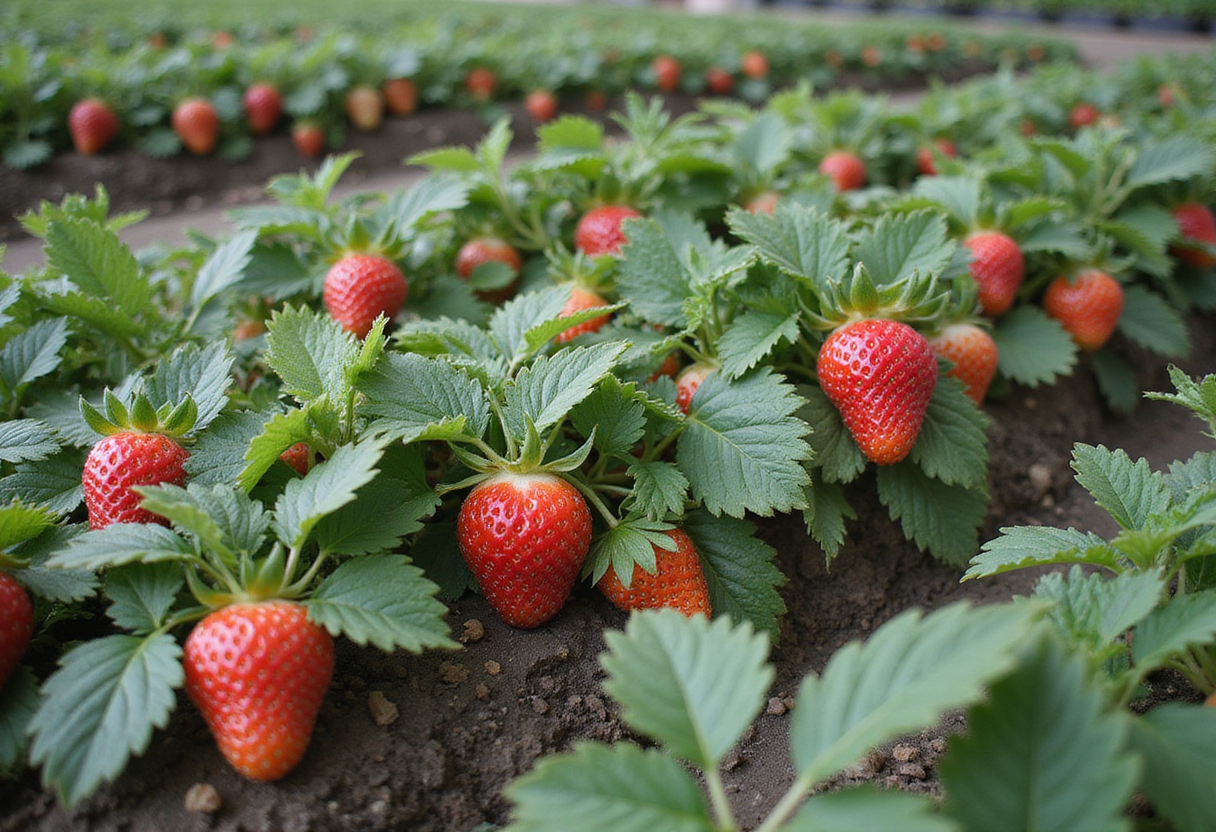
The textile, branded Plant Armor, drapes over strawberry plants as a physical barrier. Its three-dimensional porous structure blocks insects while letting sunlight, rain and airflow pass through. In field trials, covered plants produced up to 3.56 times more harvestable fruit than uncovered controls, with no negative impact measured on relative humidity, light availability or vegetative biomass.
The yield result contradicted the researchers' own expectations. Because the fabric appears opaque, the team anticipated reduced light reaching the plants, pushing them toward leaf and stem growth at the expense of fruit.
"We expected that Plant Armor's seemingly opaque fabric would lead to an increase in vegetative biomass at the expense of fruiting," said Gabriel Olawuyi, graduate research assistant at NC State and lead author of the research paper. "However, we found the fabric did not impede access to light at all, and fruit production increased significantly."
The cover also delivered a consistent warming effect across the growing seasons. According to the researchers, this helped plants accumulate the heat units required to progress through developmental stages and reach fruiting earlier than uncovered plants.
In laboratory bioassays, the porous textile achieved complete exclusion of aphids. That physical protection could cut growers' dependence on conventional pesticides while air and water still reach the crop — a compliance-relevant proposition in a segment where residue limits and pesticide restrictions keep tightening.
The product line has an unusual R&D lineage. Plant Armor grew out of earlier NC State work on textile structures for military use, originally targeting more comfortable body armour and mosquito protection for soldiers.
"The path to Plant Armor started with trying to make a cloth to go on a soldier's chest to make body armour more comfortable," said R. Michael Roe, William Neal Reynolds Distinguished Professor at NC State and co-author of the study. "Then, through trial and error, we arrive at a product which could triple the output of strawberry farms here in North Carolina."
The strawberry results build on previous NC State work in which a 3D spacer fabric used as a crop cover increased cabbage vegetative growth by 2.93 times while resisting insect penetration.
Researchers say further on-farm testing is needed to establish how the technology performs with different crops and under varying geographical and climatic conditions — the key uncertainty before any scaled agricultural rollout.
The study, "Knitted 3-D, Porous Textile Cover to Enhance Strawberry Fruit Production and Prevent Insect Feeding," was published in the journal Agriculture on 24 September 2026. The Plant Armor Gen 2 textile used in the research is patented by NC State University and licensed for commercial development. The project drew on researchers from three NC State colleges: the Wilson College of Textiles, the College of Natural Resources and the College of Agriculture and Life Sciences.
For knitters and technical-textile producers, the signal is clear: a patented, licensed 3D spacer structure has now demonstrated a 3.56x yield gain and full aphid exclusion in field conditions. Mill and flat-knit capacity positioned in agrotextiles should track the on-farm validation programme — broadacre crop-protection covers are a volume opportunity that sits outside apparel's demand cycles. For growers, the decision the data forces is whether physical exclusion at this performance level can substitute for pesticide programmes on high-value fruit crops.
via mdpi.com (Original)
More from James Calloway
Show full bio
Market editor covering industry trends and analytics at Softgoods Report.
94 articles