Sustainability & ComplianceTKT-8756
Nike and CMA CGM Launch Vietnam's First Fully Electric Barge
Nike and CMA CGM launch Vietnam's first fully electric barge, moving 50,000+ TEUs annually on an eight-year deal that cuts 778 tons of CO2 per year from inland freight.
- Cut
- November 5, 2026
- Sew
- 4 min
- Ticket
- TKT-8756
Construction
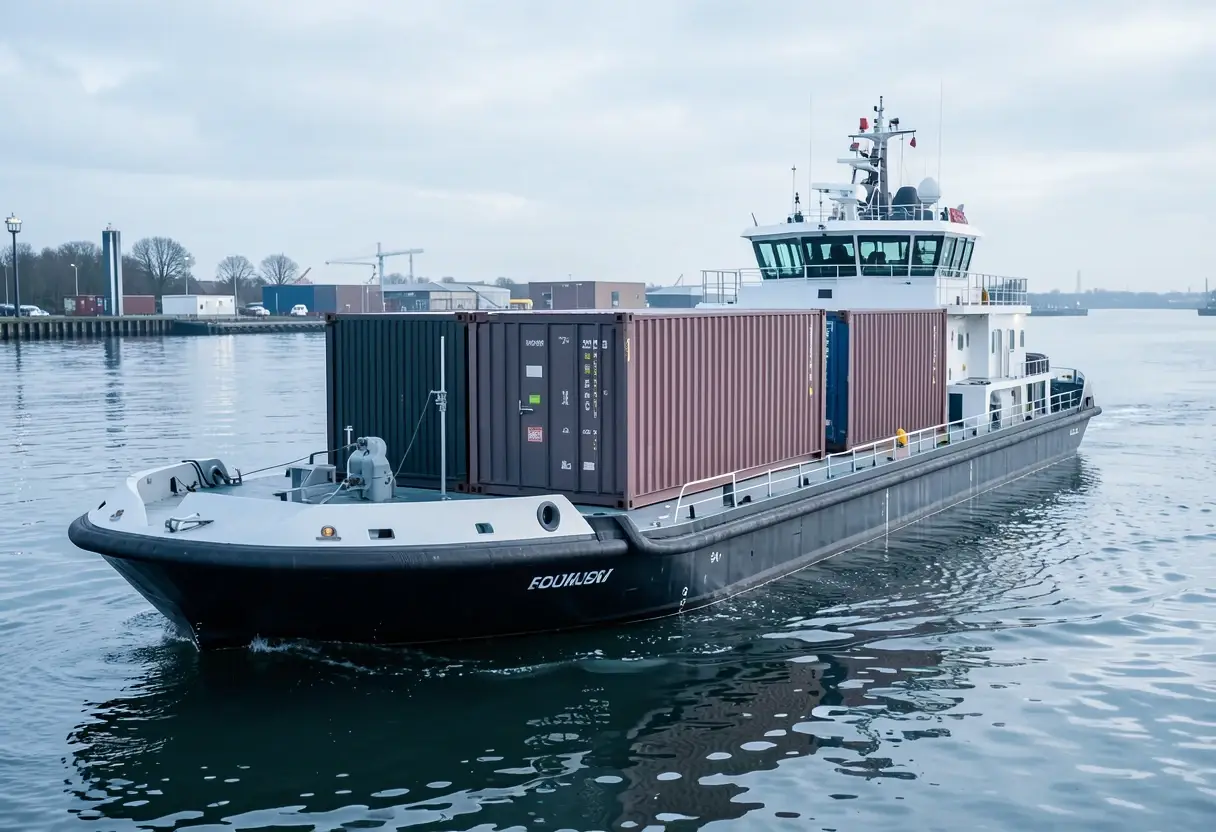
The CMA CGM Electra carries over 50,000 TEUs annually on a 112-mile zero-emission round trip, avoiding about 778 tons of CO2 per year.
Nike signed an eight-year agreement covering 90 percent of the vessel's capacity, per The Business Times.
The electric barge costs roughly twice a comparable diesel vessel, CMA CGM Asia Pacific CEO Bo Wegener said.
Vietnam produces about 52 percent of Nike Brand footwear and 34 percent of apparel in fiscal 2026.
CMA CGM's Gemalink Phase 2 expansion will raise capacity from 1.7 million to about 3 million TEUs by late 2027.
Nike has launched Vietnam's first fully electric container barge, an eight-year commitment with CMA CGM that moves more than 50,000 TEUs a year between its Ho Chi Minh City consolidation hub and the Gemalink deep-sea terminal at Cai Mep Port. The vessel produces zero direct greenhouse gas emissions on its 112-mile round trip, and the partners estimate it avoids roughly 778 tons of CO2 annually compared with trucking.
For sourcing teams watching inland logistics costs and carbon accounting in Vietnam — Nike's largest footwear manufacturing source at about 52 percent of Nike Brand footwear and 34 percent of apparel in fiscal 2026 — the deal signals a new template for factory-to-port freight.
What are the vessel's specs and who paid for them?
The barge, named CMA CGM Electra, measures nearly 80 meters (262 feet) long with a deadweight capacity of 3,500 tons and room for 182 TEUs per sailing. The Business Times reported that Nike's eight-year agreement covers cargo filling 90 percent of the vessel's capacity.
CMA CGM Asia Pacific CEO Bo Wegener told the Singapore-based publication that the initial investment runs approximately twice the cost of a comparable diesel barge. Neither company disclosed the actual figure, nor a timetable for additional vessels.
The battery system comes from CATL. A full recharge takes roughly four hours using certified renewable electricity, and battery swaps during container handling take about 30 minutes. Dedicated charging infrastructure at Gemalink draws power from a solar farm built at the terminal.
What did the executives say?
"Reducing emissions across a global supply chain takes more than any one company. It takes new ideas, strong partnerships and a willingness to rethink how we operate," Nike chief sustainability officer Cimarron Nix said in a statement. She called the project "a great example of how we can turn innovation into practical solutions that reduce our impact while strengthening the resilience of our supply chain."
CMA CGM frames this as a system, not a one-off ship. Nike has committed to optimizing the barge for its shipments between Binh Duong province and Gemalink. Christine Cabau, the carrier's executive vice president for assets and operations, said the project "can be replicated easily in other geographies and with other major customers." She added: "We are looking forward to duplicating and adapting this innovative solution with other cargo owners wishing to find solutions towards more sustainable transport modes."
How does this fit Nike's emissions math?
Transportation is one of four emissions focus areas for Nike, alongside materials, manufacturing and its own operations. The company says inbound and outbound transport emissions fell 56 percent from fiscal 2020 to fiscal 2025, driven largely by mode shifts. Inbound air freight dropped nearly 85 percent since 2020 and represented only 0.6 percent of inbound volume in fiscal 2025.
On the ocean leg, Nike joined six of its carriers' sustainable fuel programs, matching the equivalent of 28 percent of its global inbound ocean shipments. The CMA CGM relationship predates the barge: from July 2023 to May 2024, Nike used sustainable biofuel for 36 percent of its volume with the carrier, cutting 25,000 tons of CO2.
What's the wider Vietnam play for CMA CGM?
The carrier owns a 25 percent stake in Gemalink, which has run at full capacity since opening in 2021. A Phase 2 expansion launched in April 2026 will lift terminal capacity from 1.7 million TEUs to roughly 3 million TEUs by late 2027, via a quay extension, a larger yard and five additional cranes. CMA CGM is also investing $600 million in a deep-water terminal at Hai Phong, its first facility in northern Vietnam.
The barge supports CMA CGM's net-zero-by-2050 target, alongside an October agreement with DSV targeting a 12,000-ton emissions cut over two years through second-generation biofuels. A separate electric and hybrid inland barge on France's Fos-Lyon Rhône corridor is due in 2028.
For sourcing directors, the decision point is straightforward: at double the capital cost of a diesel vessel, electric inland barge capacity in Vietnam now exists as a bookable, Nike-anchored model — and CMA CGM says it will replicate it for other cargo owners.
via Sourcing Journal (Source)
More from Olivia Hart
Show full bio
Senior reporter covering regulation, policy and their impact on Light industry and softgoods manufacturing at Softgoods Report.
310 articles