Sustainability & ComplianceTKT-FE42
Dhaka garment factory fire kills at least 16 workers
At least 16 workers died in a Mirpur factory fire fed by an unlicensed chemical warehouse, with a locked roof door blocking escape. Owners remain unidentified.
- Cut
- October 1, 2026
- Sew
- 4 min
- Ticket
- TKT-FE42
Construction
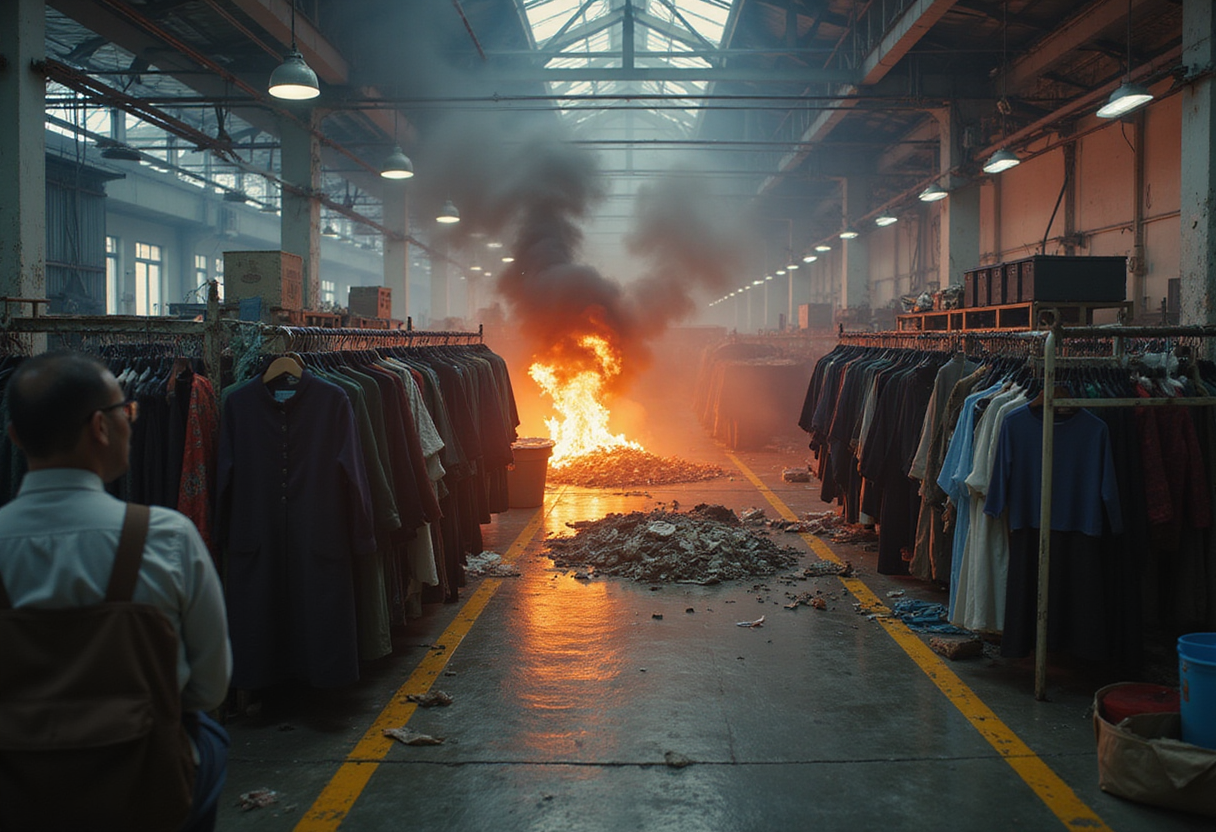
At least 16 workers killed on 14 October 2025 in a fire at a garment factory in Mirpur, Dhaka, which spread from an adjacent chemical warehouse
Fire service says neither the factory nor the warehouse had operating approval or fire safety plans; the factory's roof door was locked, blocking escape
Bangladesh RMG exports totalled $38.48 billion in FY 2024-25, 81.49% of national exports; US imposed a 20% tariff on Bangladesh in August
At least 16 garment workers died on Tuesday, 14 October, when a fire tore through a four-storey factory building in Mirpur, Dhaka. Fire service officials expect the death toll to rise as the blaze in an adjacent chemical warehouse remained uncontrolled.
The fire started at approximately 11 a.m. in the chemical storage warehouse and spread to the garment factory. Firefighters extinguished the factory fire within three hours but continued fighting the warehouse blaze.
"Sixteen bodies have been recovered so far, but there could be more casualties at the nearby chemical warehouse, where the blaze is not yet under control. It is unclear how many people were inside at the time," said Lt. Col. Tajul Islam Chowdhury, director of the fire service, speaking to local media. He added that victims probably died "instantly" after inhaling "highly toxic gas" produced by burning chemicals.
Preliminary findings point to two compounding failures. First, neither the garment factory nor the chemical warehouse held approval to operate at the site, and neither had fire safety plans in place, according to Chowdhury. Second, escape routes were blocked. The factory had a tin roof and a grilled door kept locked.
"The victims could not escape because the roof door was locked," said fire service official Talha Bin Zasim. "Most of them died from inhaling toxic gas, rather than burns."
Chowdhury said the chemical explosion triggered a flashover, releasing gases that rendered workers unconscious and trapped them inside, blocking escape both upward and downward. Many bodies were burned so badly that DNA testing may be the only means of identification. Police and the army are working to locate the factory owners, who have not yet been identified.
An eyewitness described the sequence: "We heard a huge explosion. Then we saw a massive fire. Then it spread to the next building." Another eyewitness said the chemical warehouse stored bleaching powder, plastic and hydrogen peroxide — materials that intensify fires and release toxic fumes when burned.
Family members gathered at the site searching for missing relatives. The father of Farzana Akhter, still unaccounted for, told Reuters: "When I heard about the fire, I came running. But I still haven't found her. ... I just want my daughter back." Mohammad Nayeem said officials directed him to check hospitals for his wife, Samia Akter, employed at the factory. "I went twice to Dhaka Medical, but couldn't find her," he said.
Bangladesh's interim government head Muhammad Yunus expressed "deep sorrow" and urged authorities to investigate and support victims and families, according to the report.
Sector context
Bangladesh ranks as the world's second-largest ready-made garment exporter after China, holding 5–6 percent of the global market. RMG accounted for approximately 81.49 percent of the country's total exports in FY 2024-25, earning $38.48 billion. The sector employs more than 4 million workers, most of them women.
The Mirpur fire renews scrutiny of a sector with a documented fire-safety record. According to the Fire Service and Civil Defence Department, 414 garment workers died in 213 factory fires between 2006 and 2009. The Tazreen Fashion fire in Ashulia killed 124 workers in November 2012. The Rana Plaza collapse in April 2013 killed 1,134 workers and injured more than 2,500.
The Rana Plaza disaster produced the Bangladesh Accord on Health and Safety, now the International Accord on Fire and Building Safety, under which global brands, retailers, unions and supplier factories committed to factory safety in Bangladeshi supply chains. Tuesday's fire at an unapproved facility with locked exits will intensify questions about the limits of Accord coverage, which historically centred on inspected ready-made garment units rather than adjacent or upstream chemical storage operations.
The disaster also lands on an industry under commercial strain. The United States imposed a 20 percent tariff on Bangladeshi goods in August, and retailers including H&M, Walmart, Adidas, Levi's and VF Asia have pressed suppliers for competitive prices, according to the report — pressure that worker advocates link to cost-cutting across the supply base.
The report also noted that tens of thousands of garment workers staged strikes and protests last October and November demanding a monthly minimum wage increase from 8,000 taka ($67) to 22,000–25,000 taka ($184–209), along with improved workplace safety. The interim government deployed police and army units in response.
The compliance decision
For sourcing directors, the Mirpur fire presents an immediate due-diligence question: whether current audit protocols capture unlicensed co-located operations — chemical warehouses, printing and washing units — adjacent to Tier 1 cut-and-make factories. Any brand with Dhaka production will now face calls to verify factory licensing status, chemical storage separation and unlocked egress routes, and to confirm whether their supplier base falls within or outside Accord inspection scope.
via youtube.com (Original)
More from James Calloway
Show full bio
Market editor covering industry trends and analytics at Softgoods Report.
94 articles