Trade & Sourcing PolicyTKT-F3C3
3.36m TEUs Await Berths as Typhoon Champi Tests China Ports
China’s container backlog fell to 3.36m TEUs before Typhoon Champi, but pilotage, gate suspensions and Taiwan’s customs shutdown threaten delays across East Asia.
- Cut
- October 30, 2026
- Sew
- 4 min
- Ticket
- TKT-F3C3
Construction
The global backlog stood at 3.36m TEUs, or 9.7% of the fleet, before Champi, down from more than 4m in early September.
Drewry recorded Shanghai waits falling from 58 to 38 hours and Ningbo waits declining from 40 to 34 hours.
No container-terminal closures were reported on Friday; Ningbo, Yangshan and Waigaoqiao were fully operational at 11 a.m. Thursday.
Sea-Intelligence’s Sept. 30 release reported August schedule reliability of 23.9% for China, 12.2% for Shanghai and 16.9% for Ningbo.
Drewry estimated that a one-day disruption takes about one week to recover at 90% berth utilization, versus two days at 75%.
By James Calloway
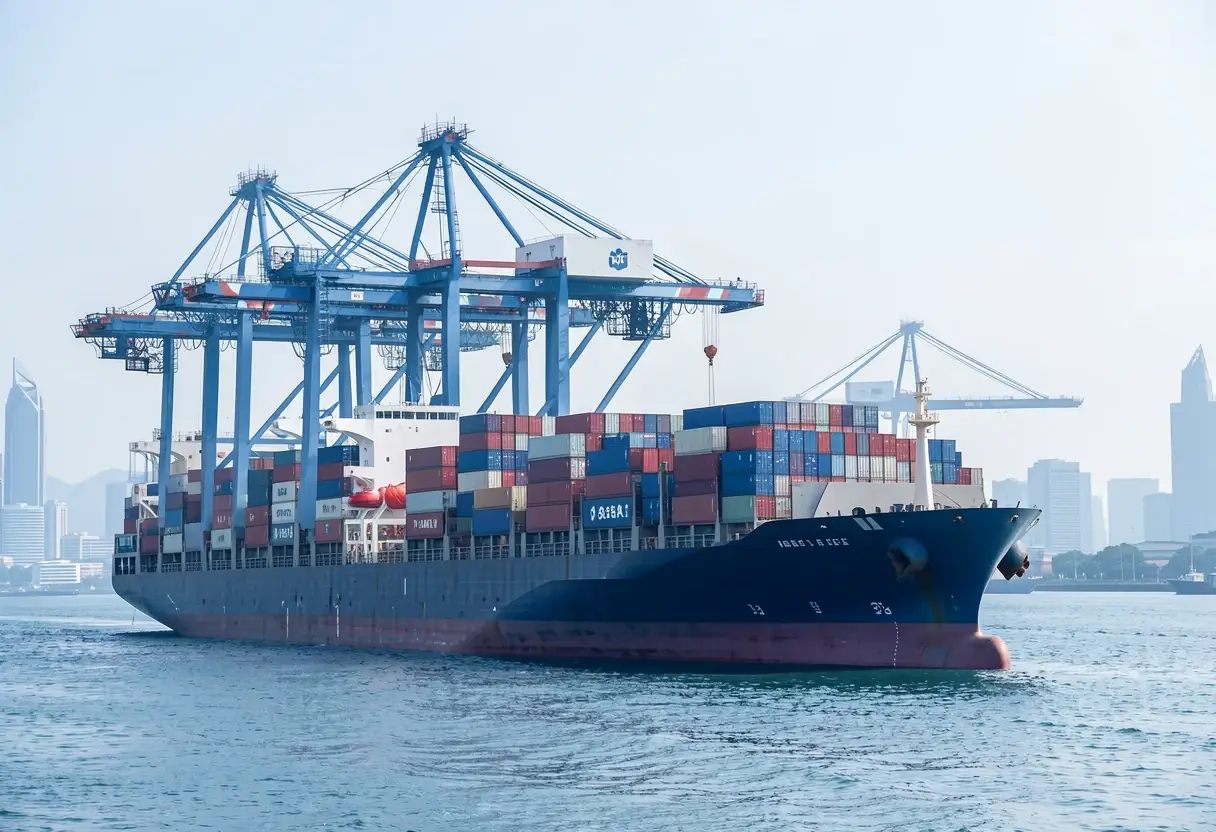
About 3.36 million twenty-foot equivalent units (TEUs) were waiting to berth globally before Typhoon Champi approached eastern China, equal to 9.7% of the global container fleet and down from more than 4 million in early September, according to Linerlytica.
Maersk told customers on Tuesday that Chinese port conditions had improved and vessel waiting times continued to decline after earlier typhoons. The carrier also warned that strong export demand continued to pressure congested ports and that intermittent delays would persist on certain trade lanes as conditions normalised.
What did the pre-Champi recovery look like?
Drewry’s Thursday data showed average waits at Shanghai falling from 58 hours to 38 hours, while Ningbo eased from 40 hours to 34 hours. Drewry said: “Golden Week provided an opportunity for ports to clear backlogs and improve schedule reliability, supported by reduced cargo volumes and blank sailings.” Blank sailings mean scheduled port calls were skipped.
Terminal-level data from Seko Logistics on Friday showed less uniform progress. Waigaoqiao was waiting one to two-and-a-half days, while Yangshan idling times ran around four days for one terminal grouping and six to seven days for the others.
Ningbo-Zhoushan’s yard density, or storage occupancy, had returned to normal after Golden Week, according to Seko, but waits still ran one-and-a-half to three days across its terminals.
Will Typhoon Champi close container terminals?
No container-terminal closures had been reported at major ports including Shanghai and Ningbo-Zhoushan when the storm threatened on Friday. The immediate risk centred on vessel movement and pilotage (harbor pilots guiding ships), not a confirmed halt to container handling.
Ferry suspensions and maritime emergency responses were already in force across Shanghai and the Fujian and Zhejiang provinces on Friday.
Kuehne+Nagel reported on Thursday, citing Lloyd’s List Intelligence, that Ningbo, Yangshan and Waigaoqiao terminals were fully operational at 11 a.m. that day. Their yards, warehouses and trucking services were also operating normally.
Seko expected temporary gate suspensions and pilotage halts for Ningbo, Shanghai, Xiamen and Fuzhou from Friday night through Monday, plus intermittent pilotage suspensions at Yangshan over the same window.
How severe was the earlier storm disruption?
For the earlier storms, Sea-Intelligence’s Sept. 30 release, based on August data, put China’s schedule reliability at 23.9%, the region’s worst. Shanghai registered 12.2% and Ningbo 16.9%, while the average delay for late vessels across Asia was 7.28 days.
Sea-Intelligence had separately projected that accumulated congestion could take seven to 10 months to ease to mid-2025 conditions, a timeline running through next summer. A return to end-of-2025 conditions could take six to eight months.
In its October Asia Pacific Freight Report, Dimerco expected the Port of Shanghai to remain heavily congested into mid-to-late October, with berthing waits above five days. The freight forwarder measured on-time performance at just 21%.
Why can a one-day disruption become a week?
Drewry’s Ports and Terminals Insight estimated that a terminal operating at 90% berth utilization—the use of available berth capacity—would need roughly one week to recover from a one-day disruption. At 75% utilization, recovery would take about two days.
Drewry said: “The difference between those two operating points, in normal years, could be the difference between a competitive and an uncompetitive return on capital.” It continued: “In a shock year, it is the difference between a manageable event and one that puts cargo on the water for an extra fortnight or more.”
What does Taiwan add to the disruption?
Champi shut work and customs operations throughout Taiwan on Friday. Seko warned shippers through Taiwan, Xiamen, Fuzhou, Ningbo, Shanghai and southwestern Japan to expect air-cargo rollovers, or shipments shifted to air freight, berthing delays, and customs and trucking backlogs early in the coming week.
Whether October’s recovery reverses will turn on how much of the forecast Friday-night-to-Monday suspension window materialises at container terminals over the weekend. The next weekly waiting-time readings will show whether pre-storm averages survived.
For sourcing teams, contingency routing and air-cargo rollover plans for eastern China, Taiwan and southwestern Japan must track confirmed terminal notices, not assumptions of either shutdown or normality.
via Sourcing Journal (Source)
More from James Calloway
Show full bio
Market editor covering people, launches and day-to-day practice in Light industry and softgoods manufacturing at Softgoods Report.
326 articles